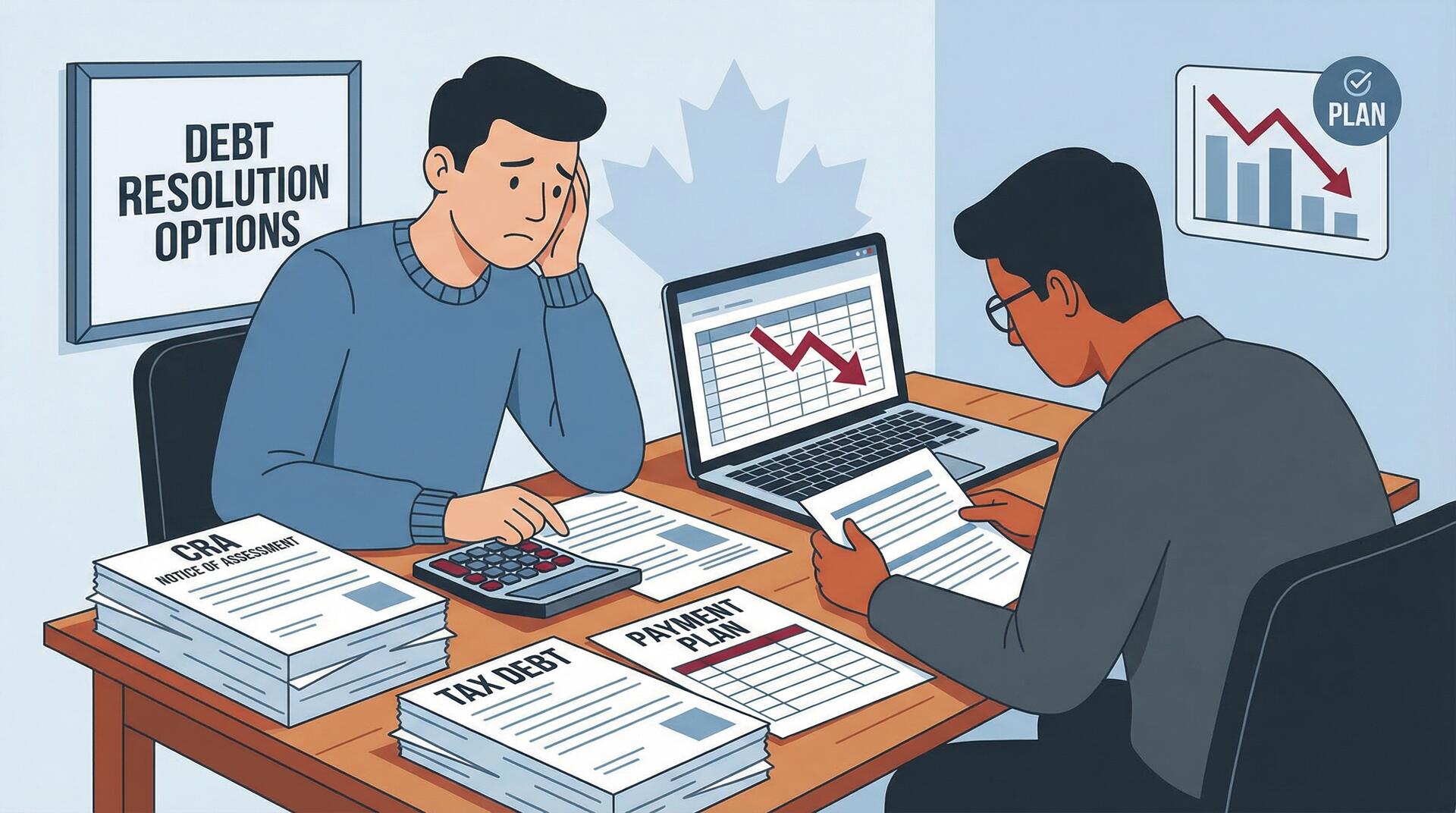
Owing money to the CRA is stressful and carries serious consequences. Learn your options for resolving tax debt, from payment plans to formal insolvency proceedings.
The CRA Doesn't Negotiate—But You Have Options
Tax debt is different from other types of debt. The Canada Revenue Agency (CRA) has extraordinary collection powers that regular creditors don't have. They can garnish your wages without a court order, freeze your bank accounts, and place liens on your property.
If you owe back taxes, ignoring the problem will only make it worse. Here's what you need to know.
Understanding CRA Collection Powers
The CRA can:
- Garnish wages directly from your employer (up to 50% of your income)
- Freeze bank accounts and seize funds
- Withhold GST/HST credits and income tax refunds
- Register liens against your property
- Certify debts in Federal Court, making them legally enforceable
Solution 1: CRA Payment Arrangements
If you can afford to pay your tax debt over time, the CRA may agree to a payment arrangement. This is the simplest solution but requires you to pay the full amount plus interest.
How to Request:
- Call the CRA Collections department
- Propose a realistic monthly payment
- Provide proof of income if requested
Important: The CRA will continue charging interest (currently around 10% annually) on the outstanding balance.
Solution 2: Taxpayer Relief Provisions
In certain circumstances, the CRA may cancel or waive penalties and interest under their Taxpayer Relief program. This applies when:
- You experienced financial hardship
- You were unable to file due to illness or disaster
- The CRA provided incorrect information
Note: This does NOT eliminate the principal tax owed—only penalties and interest.
Solution 3: Consumer Proposal
A Consumer Proposal can include CRA debt. This is often the best option for people with significant tax debt combined with other unsecured debts.
Advantages:
- Reduces total debt owed (including tax debt)
- Stops all CRA collection actions immediately
- Prevents wage garnishment and bank freezes
- Allows you to keep your assets
Example: If you owe $30,000 to CRA and $20,000 in credit card debt, a Consumer Proposal might settle the entire $50,000 for $15,000 paid over 5 years.
Solution 4: Bankruptcy
Personal bankruptcy eliminates most CRA debt, including income tax, GST/HST debts, and overpaid benefits. However, certain tax-related debts may survive bankruptcy in specific circumstances.
Tax Debts Eliminated:
- Personal income tax
- GST/HST owing
- Canada Child Benefit overpayments
- EI and CPP overpayments
Tax Debts NOT Eliminated:
- Debts arising from fraud
- Fines or penalties imposed by a court
Don't Wait for the CRA to Act
The worst thing you can do is ignore CRA notices. Once the CRA begins aggressive collection, your options become more limited. If you owe more than $10,000 in tax debt, consult with a Licensed Insolvency Trustee to explore your options before the situation escalates.